Podcast: Shahin Vallée on French Political Shock, Le Pen vs EU

Had a great conversation with French politics guru Shahin Vallee (former advisor to the President of the European Council and to the French Minister of Economy) . Listen/watch here and summary below:
Key themes:
Why the selloff happened
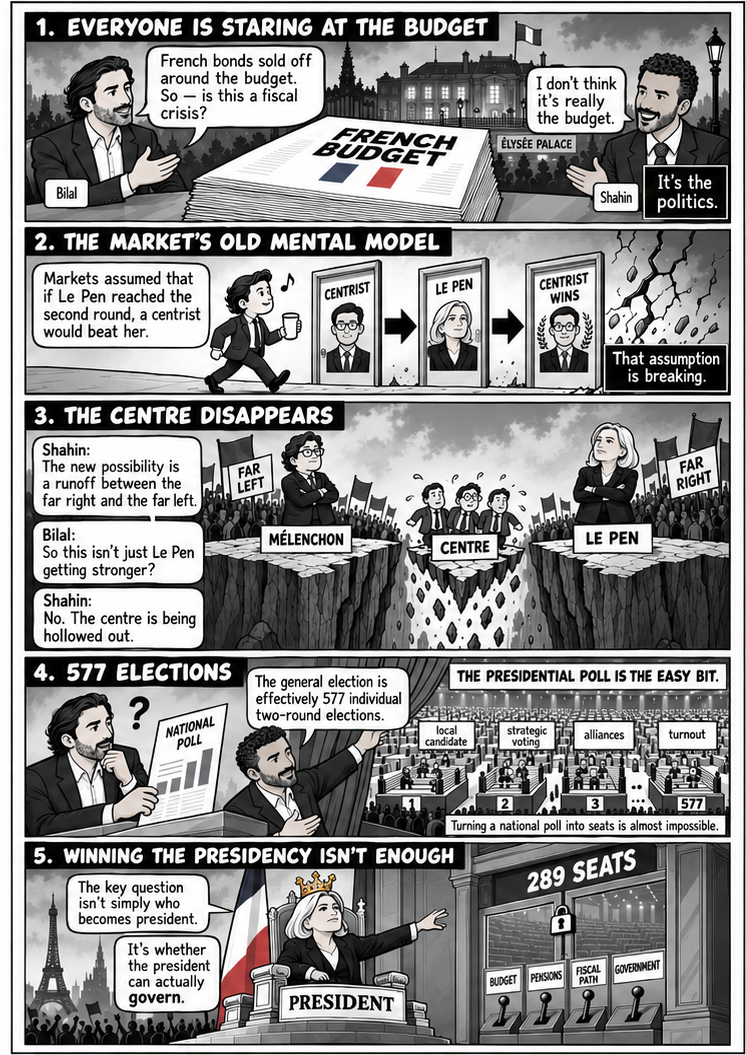
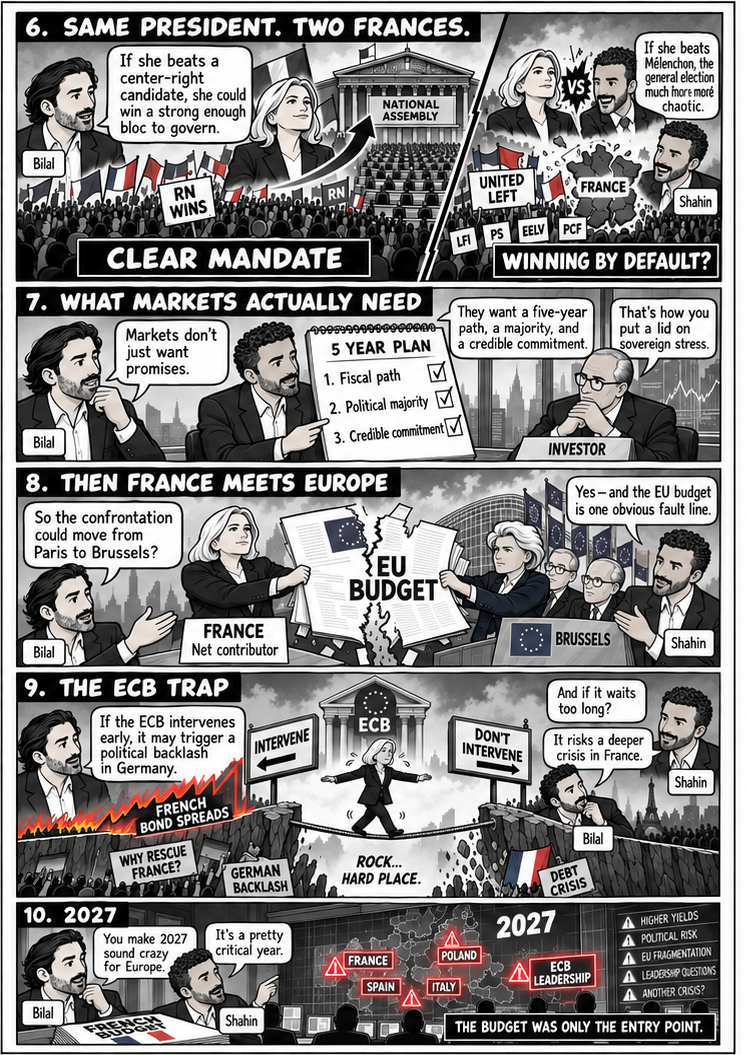
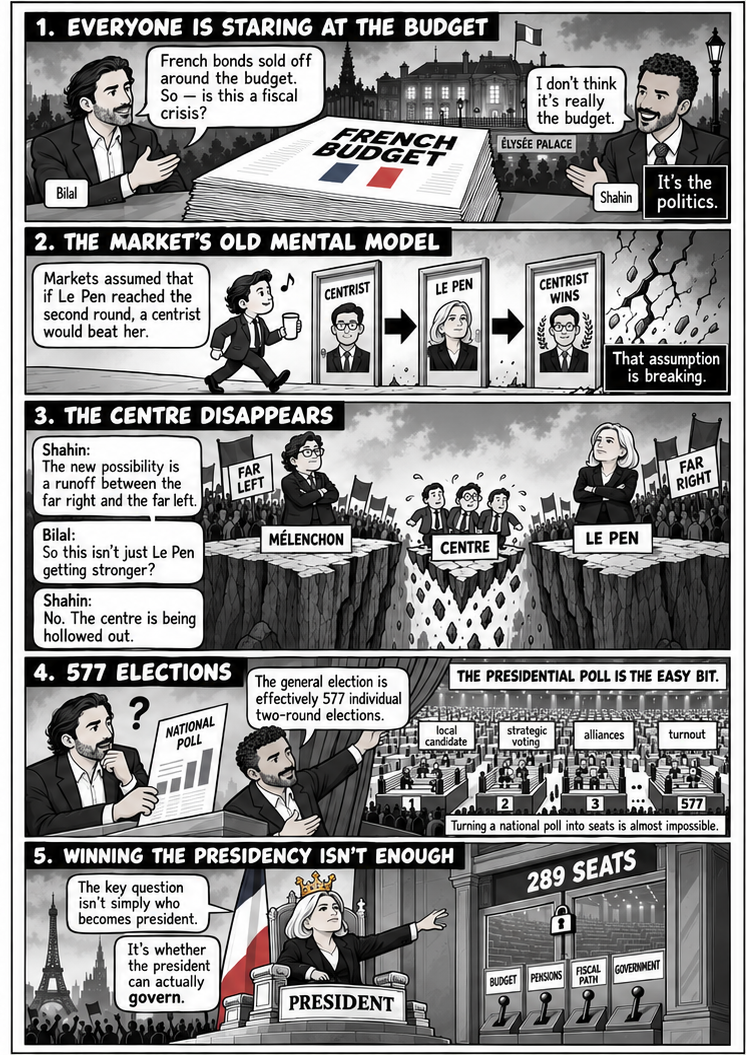
- Broken assumptions. Markets assumed a centrist would beat Le Pen and that Bardella was market-friendly. Summer polls broke the first, and Le Pen's return as candidate broke the second.
- What would calm the spread. A stated five-year fiscal path, a credible commitment to it, and a constitutional reform to deliver it. He does not expect these before a crisis forces them.
- The risk is stalemate, not extremism. He does not expect crazy fiscal expansion or a pension age of 60. The risk is no majority and no credible commitment.
Le Pen's programme
- Fiscal rule. A constitutional rule put to referendum, which he calls significant but too tight to be credible because she has not said how she would meet it.
- Other planks. Immigration cuts as savings, reversing the 2023 pension reform, and a public capitalised pension scheme. He reads the scheme as a quiet way to cut pensions without touching the retirement age.
- Le Pen and Bardella. The "Bardella is more market-friendly" idea was mostly public relations. They are converging, and he does not expect a rift.
The EU budget fight
- Contribution cut. Le Pen wants to halve France's EU budget contribution.
- Savings are small. The cut saves about 7 or 8 billion euros a year against a 120 billion adjustment. [Editor's note: the RN's own figure is 140 billion by 2032.]
- Confrontation with Brussels. She questioned whether von der Leyen can stay as Commission president.
- The Italy comparison. France's institutions give less of a check on a president than Italy's did on Meloni, and France has less financial incentive to be compliant.
- EU integration at risk. A fight over the seven-year budget could unwind the shift since the euro crisis towards common borrowing. He expects an eventual compromise after friction.
- Ratification. Any budget deal needs French parliamentary approval, which cannot come before the general election.
Reading the polls
- Polling bias. Pollsters underestimate populist votes, more so on the left, and adjust poorly for young voters. His advice is to average the public polls and correct for each pollster's bias.
- The general election is hard to poll. 577 local contests, two rounds and tactical voting.
- Private polling. His group is working with Cluster17 on constituency-level polls.
The opposition
- Mélenchon's rise. Driven by his stance on Gaza and a strategy of polarisation. He is the most disliked politician but has a strong base. Riots help both Le Pen and Mélenchon and hollow out the centre.
- Runoff odds. Le Pen wins easily, but by less than the latest 70 to 30 poll.
- The centre. Philippe carries Macron's baggage. He expects Philippe and Attal to merge by February, with polling shares not adding up. The 5% reimbursement threshold will push out weak candidates, and the Republicans' candidate polls at 7 percent.
- The left. He doubts Glucksmann's momentum will last and sees fragmentation, including whether the Greens ally with him.
The general election
- Two outcomes. If Le Pen beats a centre-right candidate, she likely gets a workable majority. If she beats Mélenchon, it looks like winning by default and the left unites.
- The 2024 precedent. France went months without a prime minister after the 2024 elections. A similar delay could leave her without one for about two months.
The ECB and Europe
- Board turnover. Half of the six-member board changes within a year. [Editor's note: Recorded on 23 October, before the announcement. On 29 October the ECB confirmed Lagarde will step down on 7 February 2027. Schnabel leaves on 3 January 2027, and Lane's term ends in May 2027. No successor to Lagarde has been named.]
- The ECB's bind. Backing France early could boost the AfD in Germany. Waiting risks a French debt crisis. He compares it to the euro crisis.
- Other 2027 elections. Spain, Italy and Poland.