Podcast: Nadrowski on Asymmetric Warfare, Energy Crisis and AI Life

Great chat with iconoclast Nadrowski. Link and summary below:
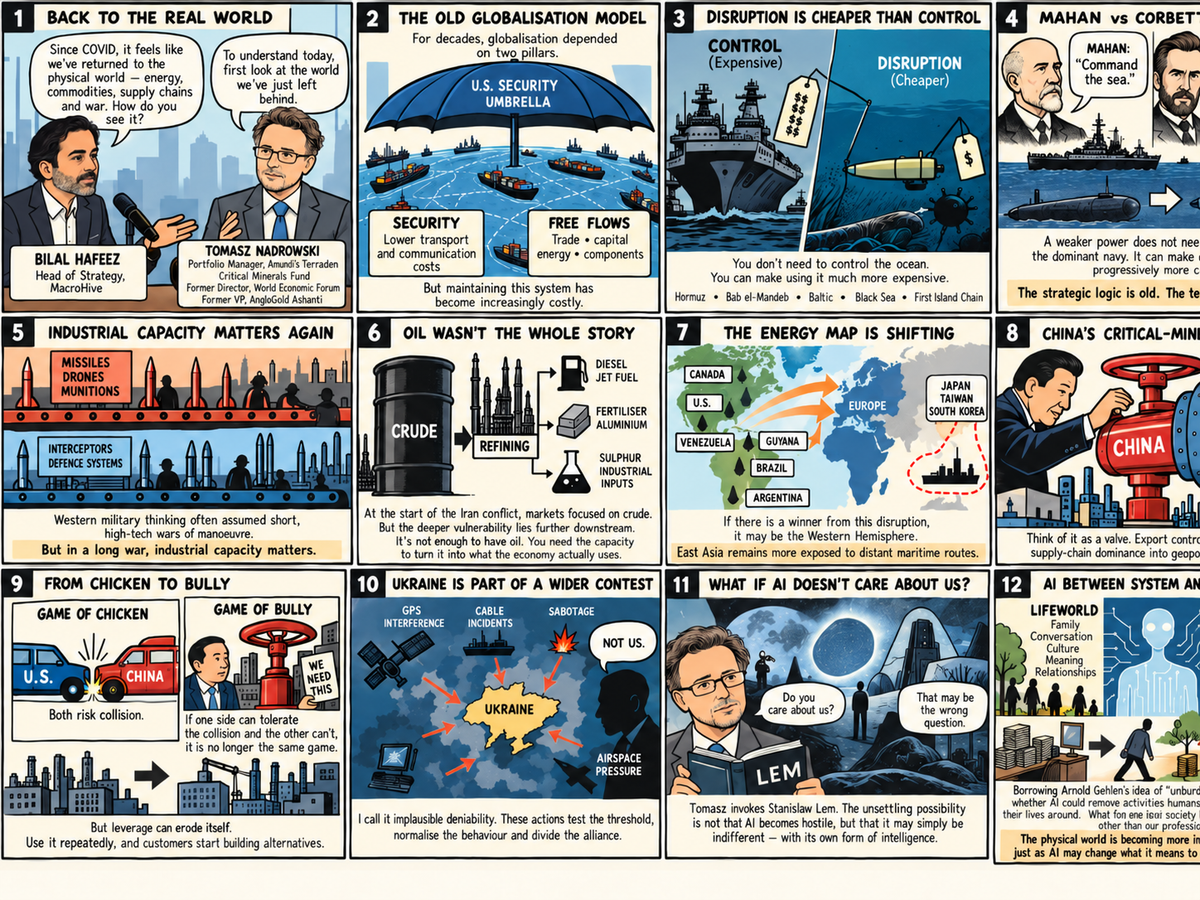
Summary: Thomas Nadrowski, a critical minerals fund manager, argues that the post-1991 globalised order is breaking down. US power is declining relatively, and cheap tools such as drones, mines and undersea vehicles let weaker states disrupt shipping and cables more cheaply than the US can defend them. He links this to the Iran conflict, refining shortages and China's use of critical minerals as leverage. His view is that Western reindustrialisation, especially in defence, energy and manufacturing, is now unavoidable. He ends with an optimistic but cautious view of AI as a force that removes burdensome work and may create shared background assumptions.
Key facts:
- Old order: security cut transport and communication costs and made global trade profitable. Nadrowski says holding that order is now costly while disrupting it is cheap.
- Energy: crude spiked less than feared in the US-Iran war, partly because China built a strategic reserve he says was close to twice the US level. Focus has moved to refined products, because years of low Western refining investment left little new capacity.
- Supply risk: China, Russia and the Gulf are no longer reliable suppliers of refined products. Western Hemisphere oil output (Brazil, Argentina, Venezuela, Guyana, US, Canada) is growing and may reduce Persian Gulf dominance, though it helps Northeast Asia less than Europe.
- China: he says it benefits from a prolonged Ukraine war and feels stronger after the 2025 trade fight. It reacted to EU sanctions by sanctioning European firms and a Polish university.
- Critical minerals: the US rejected a Chinese offer to extend the Busan reprieve by two years. A tightening of the defence acquisition rule (DFARS) in January will bar defence sourcing from China and other foreign entities of concern. He frames this as a game of chicken on the defence side and a game of "bully" on the civilian side. Natural flake graphite remains almost entirely Chinese-controlled, while a new solvent extraction plant in southern France shows rare earth progress.
- Russia: he says it can make 3,000 jet drones and over 100 ballistic missiles a month, while Europe lacks equivalent capacity. He describes grey-zone attacks (GPS jamming, cable cutting, arson) as testing thresholds, normalising aggression and dividing Europe.
- AI: he sees AI as present in both the "system" and the "life world" (Habermas). He is cautiously optimistic and cites Arnold Gehlen's idea of relief from burdens. His concerns are young people treating AI as pure output, and AI shifting society away from profession-based roles.