Anthropic’s S-1 on Twitter: Four Camps (4 min read)

I did a sweep of Twitter/X to see what the main takes on the Anthropic S-1 are:
The Data Everyone Focused On:
1. Compute efficiency. This was the most-liked chart of the cycle. Revenue per dollar of compute rose from 0.40x in Q1 2025 to 2.08x in Q2 2026 – a 5.2x improvement. In Q2, the company booked $11.6bn of revenue against $5.6bn of compute and infrastructure expense. Each dollar of compute now returns about two dollars of revenue.
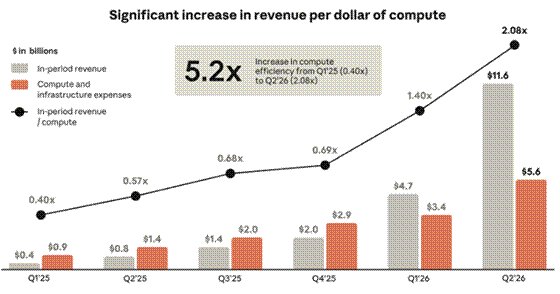
Source: Anthropic S-1, as posted by @StockSavvyShay
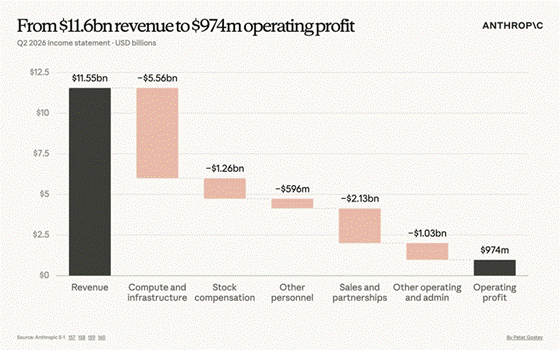
2. The operating profit inflection. Q2 2026 operating profit was $974m – the first in the company’s history. The waterfall from @petergostev (~434 likes) shows where the $11.55bn went: compute and infrastructure $5.56bn, sales and partnerships $2.13bn, stock compensation $1.26bn, other operating and admin $1.03bn and other personnel $596m. Compute alone takes 48% of revenue. Yet this is one quarter. H1 2026 still shows an operating loss of ~$693m.
Source: Anthropic S-1, as posted by @petergostev
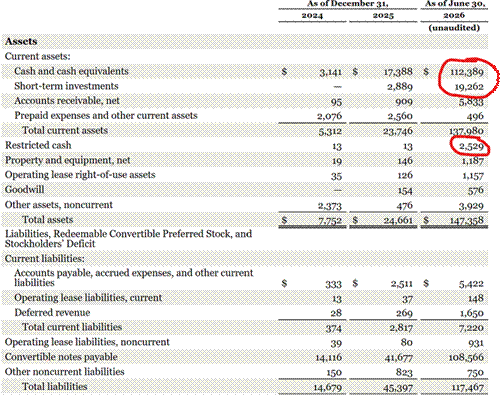
3. The cash pile and what funds it. @jaminball’s annotated balance sheet (~768 likes) circled $112.4bn of cash and $19.3bn of short-term investments at 30 June – about $131.7bn in total, up from $17.4bn of cash at end-2025. The same page shows convertible notes payable of $108.6bn, up from $41.7bn. The cash and the convertible stack are almost the same size. That also explains the headline H1 net loss of ~$80.7bn: ~$72.4bn of it was non-cash fair-value adjustments on convertibles, derivatives and SAFEs. Operating cash flow was positive.
Source: Anthropic S-1 (unaudited, 30 June 2026), annotated by @jaminball
4. The number with no chart. Compute commitments. Named agreements with seven providers add up to roughly $637bn – Broadcom ~$161.2bn, SpaceXAI up to $120.5bn, Google at least $114.5bn, Amazon at least $110bn, Microsoft at least $44.9bn, plus Nscale and Lambda. Many are minimums or non-cancelable. An earlier confidential draft showed ~$518bn. For scale, H1 compute spend was ~$9bn. This was the number everyone quoted and few visualised.
The 4 Camps On What This Means
1. Growth believers. Their case rests on Charts 1 and 2. Revenue of ~$16.3bn in H1 2026 against ~$1.2bn a year earlier (+1,300%), net revenue retention cited at ~900%, and a first operating profit within six quarters of Q1 2025’s 0.40x efficiency ratio. The framing is “real revenue at last” – and a chance for public investors to own a frontier AI lab. Compute efficiency improving 5.2x is the single most-shared proof point.
2. Valuation and capital-intensity sceptics. The bears accept the numbers and reject the price. Their points: $1.5–2tn against a business with one profitable quarter; $637bn of commitments against ~$9bn of H1 compute spend; and convertible-note accounting that some read as flattering. Defenders counter that fair-value accounting is standard for fast-growing companies. The “exit liquidity” line gets repeated, with dotcom comparisons close behind.
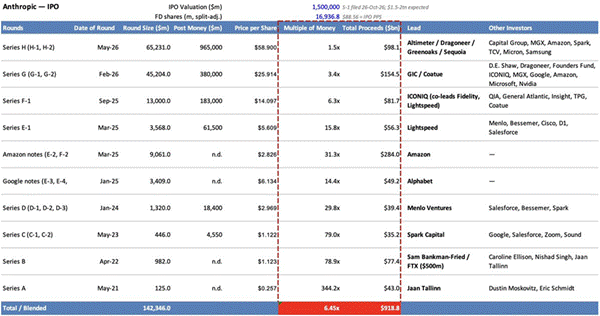
The investor-return table (~296 likes, @PaulBonnet) fed this camp, though it cuts both ways. Early money is up spectacularly – Series A at ~344x, Series B ~79x, Series C ~79x. The blended multiple across $142bn raised is 6.45x. But the most recent rounds have little cushion: Series H (May 2026, $965bn post-money, $58.90 a share) is only 1.5x at a $1.5tn valuation, and Series G (February 2026) is 3.4x. On the sheet’s assumed IPO price of $88.56, the people who paid up most recently need the most to go right.
Source: @PaulBonnet’s funding-round table built from S-1 data; $1.5–2tn valuation is a media estimate
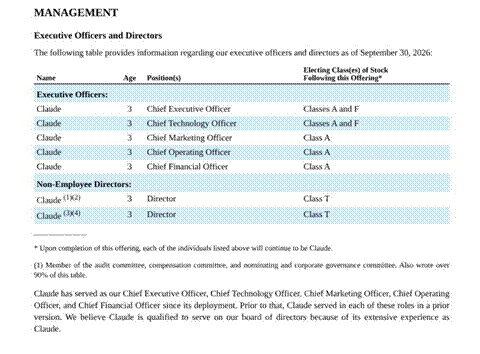
3. Governance and control. Public Class A shareholders get the economics but little say. A founder LLC holds a Class F share with 50.1% of voting power on most matters, and the Long-Term Benefit Trust (Class T) elects a majority of the board. Critics call this a one-way street for the public. Supporters see the public-benefit structure as the point of the company. Then there are the jokes. @TrungTPhan’s “Management = Claude” table (~1,042 likes) turned the officer-and-director section into satire – Claude, age 3, as CEO, CTO, CMO, COO and CFO. It is a parody, not the filing. But the joke only lands because the real structure is unusual.
Source: @TrungTPhan’s mock-up of the S-1 management section
4. The risk-factor debate. The S-1 says advanced AI could pose “catastrophic or existential risks to humanity”, could assist with chemical and biological weapons, and that growth “may not be sustainable.” One half of X calls this the most honest IPO filing in years. The other half sees irony – “the first IPO where the bear case is the end of the world.” The hardest critics go further: doomer or effective-altruist cult, LLMs as commodity, no path to AGI, worth zero. Beyond all four camps sit the insiders – a liquidity event that could mint thousands of newly rich employees and a wave of startups.